
What is MQTT?
MQTT is a lightweight messaging protocol whose message may vary from as simple as “21.1” to incredibly complex. The protocol was initially developed to connect remote devices via satellite. Being lightweight minimized necessary bandwidth on the use-based satellite connections. MQTT use quickly spread to a variety of areas, such as powering the technology behind Facebook Messenger and Internet of Things (IoT) devices.
What Makes MQTT Different?
MQTT uses a Publish/Subscribe (Pub/Sub) model instead of traditional client-server request-responses or poll-based models. Any device or application can both publish and subscribe to information within the network. This creates a hub-and-spoke model where all device and application are peers. This contrasts the traditional linear model that uses point-to-point connections for each system. For example, a PLC would connect to SCADA/HMI, then to MES, ERP, etc. This change is known as “collapsing the stack”.
What Makes MQTT Better?
The Pub/Sub architecture utilized by MQTT enables simplified communication between systems. For example, if I have a benchtop instrument where the value is needed by multiple systems, all I need to do is publish the data. Every other system (SCADA, MES, Historian) will be subscribed and will receive that data without linear integration.
MQTT is also scalable. Applications and devices subscribe to topics, which have a hierarchical structure. A typical structure may be:
<enterprise>/<site>/<area>/<line>/<cell>
By subscribing to a higher level, such as <enterprise>/<site>/#, messages are automatically received from any new devices or applications publishing to a lower level without additional configuration.
What Makes MQTT an Industry 4.0 Solution?
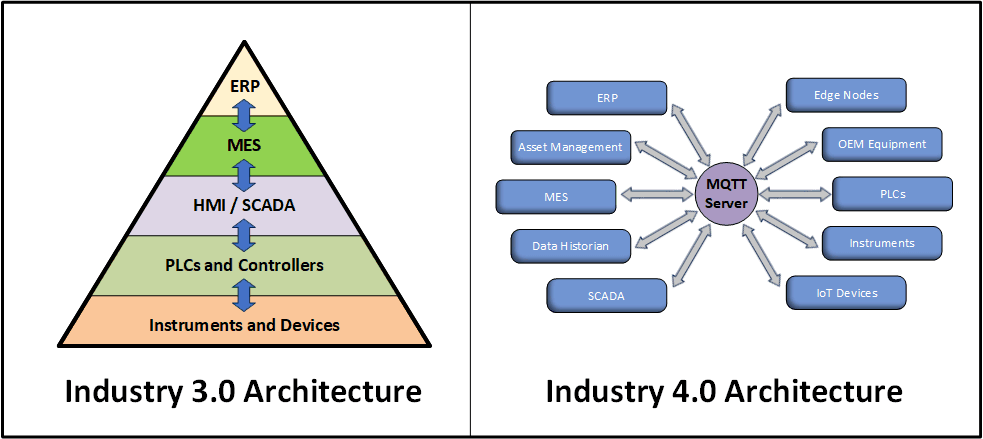
A large part of Industry 4.0 centers around IIoT devices, with more intelligence built into equipment (e.g., benchtop analytical devices). MQTT and Pub/Sub allow for easy integration of these smart edge devices.
MQTT promotes interoperability, allowing for decoupling of publishers and subscribers. A device publishing data does not need to know who is subscribing to it. This simplifies system design and allows for greater flexibility.
The lightweight protocol allows for massive amounts of data to be collected and transferred across the network, enabling the use of data driven 4.0 technologies like machine learning, data analytics, and cloud computing. The MQTT protocol is just one of many 4.0 technologies that stand to simplify data movement.